WATCH THIS SPACE: WREN workshop in Bournemouth 14-15 November

The WREN workshop is now underway!  Bournemouth’s Centre for Media History is hosting WREN workshop, where we are coming together to plot our next move.    In now-traditional WREN style, this began with an excellent curry:

IMG_3198

Kate Murphy gives dhosa instructions….

In addition to group discussions for future plans, Friday afternoon will feature an open panel discussion about the key issues we are seeking to address.

Friday 14 November 2014

14.00 – 15.30 in W240

(Screening Room, Weymouth House)

In Conversation with WREN

Women have played a key role in the general development of radio, both as listeners and producers, and still continue to play a vital role in the contemporary radio landscape.

Join our international panel for a discussion about WREN research and women’s contribution to radio.

Speakers confirmed include:

  • Maria Williams, Sound Women
  • Caroline Mitchell, Sunderland University
  • Nazan Haydari, Istanbul Bilgi University
  • Carolyn Birdsall, University of Amsterdam

Watch this space for more soon….

BBC World Service’s new all-female programme

Spotted thanks to the Sound Women:


later this month the BBC World Service will start a new all-female programme, The Conversation:


The BBC World Service is launching a new weekly programme with an all-female line up. The Conversation starts on Monday 27 October (2030 GMT). Each week the programme will explore the success stories of two women from around the world who work in similar fields, through a conversation hosted by the BBC’s Kim Chakanetsa.


While the fields of experience have expanded substantially, this kind of programming has a genealogy that stretches back at least to the 1930s.  Lilian van der Goot, who co-founded the International Association of Women in Radio and Television, (and herself ran a long-running programme called “Een kort gesprek van vrouw tot vrouw” [A short chat from woman to woman] on the Dutch AVRO) claimed to have been inspired by such programming –  on the BBC overseas service.  She specifically mentioned Olive Shapley’s “Miner’s Wives,” in which miner’s wives from France and Britain found common ground in their shared experiences.

Will be very curious to hear the new show!

Entangled Media Histories seminar in Lund

alecbadenoch's avatarAlec Badenoch

So the end of this last week I was on the road again for the first time in a while.  It began with a trip to visit the Department of Media and Communication at Lund Unversity, specifically the Media History group, where I was invited to give a seminar in their seminar on Cold War history.  Lund is one of three partners in the Entangled Media Project (together with Centre for Media History at Bournemouth Unversity and  Hans Bredow Institute for Media Research, Research Centre for the History of Broadcasting in Northern Germany, Hamburg) that explores transnational entanglements in media history.

In short, my kinda folks.

I got to share a platform with Marie Cronqvist who was presenting exciting new research on the television exchanges between Sweden and the German Democratic Republic during the Cold War.  My talk “Translating women: the entangled networks of radio…

View original post 83 more words

New Article: ‘Eleanor Roosevelt as “Ordinary” Citizen and “Expert” on Radio in the Early 1950s’ by Anya Luscombe

WREN Anya Luscombe has just published an article based on a paper presented on a WREN panel last year.

‘Eleanor Roosevelt as “Ordinary” Citizen and “Expert” on Radio in the Early 1950s’ 

Eleanor Roosevelt, former First Lady of the United States, used radio to communicate on a wide variety of issues that she felt the American public, and women in particular, should know or think about. She had been a radio pioneer, broadcasting from the 1920s onward and starting with her own radio show in 1932. By the 1950s, radio as a technology began facing increasing competition from television. Yet, as a medium to reach mass audiences and women in particular, radio continued to play a vital role. From October 1950 until August 1951, Eleanor Roosevelt together with her son Elliott hosted a daily show on the National Broadcasting Company (NBC) called The Eleanor Roosevelt Program. Focusing on this 1950-1951 program, this article seeks to examine the way in which Mrs. Roosevelt communicated with her listeners and successfully blended that which at first sight might seem opposites: the domestic with the global, the informal mode of address with the serious topics, the public with the private, and the ordinary woman’s view with that of the expert international stateswoman.

The article is available online at SAGE OPEN (for free)

WREN in Paris

In May, I had the privilege of attending a workshop on women in ICT at my former workplace, the Institut des Sciences de la Communication (ISCC).  This was organized between two research strands at the LabEx EHNE, my former colleagues at the Strand 1: Europe as a product of material civilisation and strand 6, devoted to writing a gendered history of Europe  The workshop took a long-term perspective, exploring women’s roles in a number of communication technologies, from telegraphy, discussed by the brilliant Simone Müller-Pohl, to the roles of women in computing – back when ‘computer’ meant a person – usually an underpaid woman, who was performing the massive series of calculations needed to conduct science the the mid-20th century.

As part of this effort, a number of people were interviewed, including me, on my research on women and radio.  Of course WREN was a big part of this…

You can see it online at LabEx strand 6, or below:

Kate Frye’s Suffrage Diary: In Bed – Photographed With Radio Headphones At The Ready – 1920s

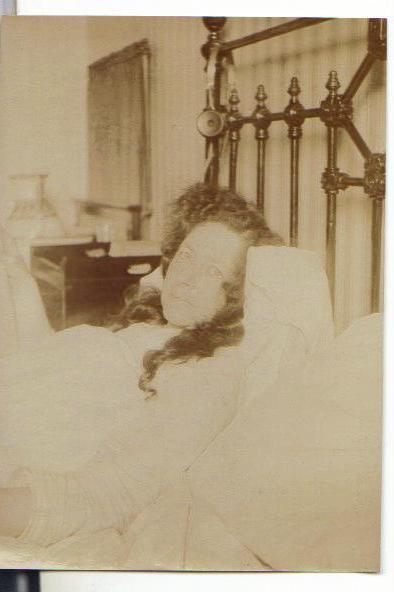
Whilst looking online for images of radio and women (partially because I was reminded of such images by a photo of a more recent Katharine), I came across this lovely one of suffragist Kate Frye on the blog of the women’s suffrage historian Elizabeth Crawford, who has also published Kate’s diary leading up to suffrage in 1918.   (The whole blog is well worth reading!) As Ms Crawford notes, Kate was an avid radio listener – as attested to by the photo here, where the radio headphones hang casually over the headboard. It is not only unusual to see a photo of a woman in her bedroom from this era, but I also have to say this is the first image I have seen of radio outside of a sitting room. Elizabeth Crawford is currently developing a documentary for ITV based on Kate Frye’s life (and diary) and it will be great to see what remnants of radio listening might appear.

womanandhersphere's avatarWoman and her Sphere

Kate in bed

Working my way through Kate Frye’s extensive collection of photographs I have just come across this one. It is so unusual to see a photo of a woman lying in bed that I thought I must share it with you all. You’ll note the radio headphones hooked on the brass bedstead which probably dates the photo to the second half of the 1920s. The photo would have been taken by Kate’s husband, John Collins, who was a keen photographer. Kate, for her part, was a keen and early radio listener, delighting as she did in all forms of music and drama.

View original post

International Women’s Day – Fem FM Revisited

ImageHandler

In 1992, over 200 women madhistory in Bristol by setting up the UK’s first women’s radio station – Fem FM. Bristol Record Office has digitised the original broadcast tapes, now available for research as part of the Fem FM archive of recordings, photographs and other material.

On International Women’s Day, M Shed will mark the launch of the archive by hosting a panel discussion about women’s achievements in radio over the past two decades. Is the climate better for women broadcasters in 2014?

The event is open to anyone interested in the media and how to get more women’s voices on air. Guest panellists (all originally involved in Fem FM) will include:

  • Sue Clark, Sony award-winning radio producer
  • DJ Ritu, DJ and world music guru who has broadcast with BBC London and the World Service
  • Ali Grant, chair of Bristol community station BCFM
  • Jacqui Wilson, manager of the internet station Passion Radio Bristol
  • Erin Riley, Senior BBC Producer

Chair: Caroline Mitchell, Senior Lecturer in Radio at the University of Sunderland and one of the founders of Fem FM

Listen online:
Audio documentary about Fem FM

UPDATE: check out photos of the event here

Also see WREN’s resource page for this and other research resources.

UNESCO gender equality in radio infographic

Spotted by the Sound Women, this illuminating infographic made by UNESCO for World Radio Day

UNESCO gathered the first world statistics on women in broadcasting in 1958, when they contracted the International Association of Women in Radio and Television to conduct a survey.  Documents relating to this are in the UNESCO archives in Paris.

Gender Equality in Radio

by BenStanford.
Explore more infographics like this one on the web’s largest information design community – Visually.

Conference: Remembering and Writing Women’s Wartime Lives

A conference to be held on Saturday 15th March 2014
at The National Memorial Arboretum, Alrewas, Staffordshire
This conference is organised by: The Midlands Region of the Women’s History Network,
The National Memorial Arboretum and The University of Worcester

Women have written about war at the time and in retrospect; they have been journalists, kept diaries and written committee minutes. For some writing was an escape from the restrictions and limitations of their everyday lives. Others wrote letters to their family or friends from whom they were separated and it became part of their war effort boosting the morale of the armed forces.

This conference on Remembering and Writing Women’s Wartime Lives will explore all aspects of women’s writing and include papers on :

Novelists and Women in WW1

Remembering and Writing on Life with War Time Rationing

Odette Sansom GC – The construction of a post war heroine


The violence of war in Iraqi women’s war fiction

Coffee and registration from 10:15 in morning, conference will finish at 3:45.  Conference Fee £15, £10:00 for concessions to include lunch.

Inquiries and booking to Dr Janis Lomas via  j.lomas96@btinternet.com

Full programme and abstracts, plus booking form, can be foundhere:  WHN March 2014 writing

CFP: Women, Gender and Information and Communication Technologies (Europe, 19th-21st centuries)

Call for Contrlogo01-petitibutions

Women, Gender and Information and Communication Technologies
(Europe, 19th-21st centuries)
International Symposium
Paris

15-16 May 2014
Organized by LabEx EHNE (Écrire une histoire nouvelle de l’Europe – Writing a New History of Europe),
Research strands 1 and 6 (http://www.labex-ehne.fr)
in partnership with the CNRS Institute for Communication Sciences (ISCC)

Although pioneering studies have contributed in the last few years to highlighting numerous aspects of the gendered construction of Information and Communication Technologies (ICT), via analyses concerning women telephone operators, female radio listeners, or even the ENIAC Girls, the place of women and of gender in the history of information and communication technologies remains to be reflected upon and written, whether it is the role and the representation of the two sexes regarding research, conception, utilisation or consumption.

It is hoped that these two days will compare European perspectives on the historical relations that women have maintained with information and communication technologies, since the telegraph. The study days invite transnational and interdisciplinary analyses across the long term, drawing as much upon the history of computer science and ICT as upon the history of work, organisations, consumption, education, media, and gender studies.

In touching upon imaginations, values, figures, models and practices that cut across the history of the telegraph, the telephone, the radio, the TV, the internet and digital devices, we hope to explore in particular the manner in which the history of information and communication technologies can enrich gender studies, and conversely the way in which the latter can shed light on studies related to ITC. The aim is to do so via numerous angles of approach (not exclusive of other approaches):

– Female actors of ICT: individual and collective historical figures, inventors,
programmers, researchers, professional users, consumers etc.
– The gendered representations of the public actors of ICT and their evolution
(discourses, advertising, teaching and education, imagination etc).
– The stakeholders implicated at the heart of ICT, affected by the problematic of
gender (European associations, national or transnational collectives etc).
– ITCs as producers of new spaces for the expression of gender.
– The specificity or not of European research in the gendered approach of ITCs in relation to the work carried out in North America.

Papers should be twenty minutes in length and can be delivered in French or English. The organising committee would be particularly interested in proposals integrating a diachronic dimension and those explicitly touching upon a European dimension. Proposals from postgraduate students or early-career researchers are welcome.

Submission
Proposals should be sent to fgtic@iscc.cnrs.fr They should be one page long, contain a bibliography and if possible a proposed plan.
Authors can include a summary of their publications/research and a brief biography in their initial e-mail.

Deadlines
• Deadline for submission of proposals: March 1st 2014
• Notification of acceptance: March 15th 2014
• International Symposium: May 15th and 16th 2014
This information is available on http://genreurope.hypotheses.org/

Organizers
Delphine Diaz (IRICE, Université Paris-Sorbonne, LabEx EHNE)
Valérie Schafer (ISCC, CNRS)
Régis Schlagdenhauffen (LISE, CNAM/CNRS, LabEx EHNE)
Benjamin Thierry (IRICE, Université Paris-Sorbonne)

Program Committee
Gerard Alberts (Universiteit van Amsterdam)
Alec Badenoch (Department of Media and Cultural Studies, Utrecht University)
Isabelle Berrebi-Hoffmann (LISE, CNAM/CNRS)
Niels Brügger (The Centre for Internet Studies, Aarhus University)
Frédéric Clavert (Université Paris-Sorbonne, IRICE, LabEx EHNE)
Delphine Gardey (Faculté des Sciences de la Société, Université de Genève)
Pascal Griset (Université Paris-Sorbonne, CRHI-IRICE/ISCC, LabEx EHNE)
Sandra Laugier (Université Paris 1 Panthéon-Sorbonne, IUF)
Christophe Lécuyer (Université Pierre et Marie Curie)
Ilana Löwy (Cermes, CNRS, EHESS, Inserm, Paris 5)
Cécile Méadel (CSI, MINES Paris Tech)
Ruth Oldenziel (Eindhoven University of Technology, Senior Fellow at the Rachel Carson
Center, Munich)
Jean-Claude Ruano-Borbalan (HT2S, CNAM)
Fabrice Virgili (IRICE, CNRS, LabEx EHNE)

Conference Secretary
Arielle Haakenstad (Université Paris-Sorbonne, IRICE/ISCC, LabEx EHNE)